Building Trust into ML Pipelines: Governance, Audit, and Repeatability
Series
Building Trust into ML Pipelines: Governance, Audit, and Repeatability
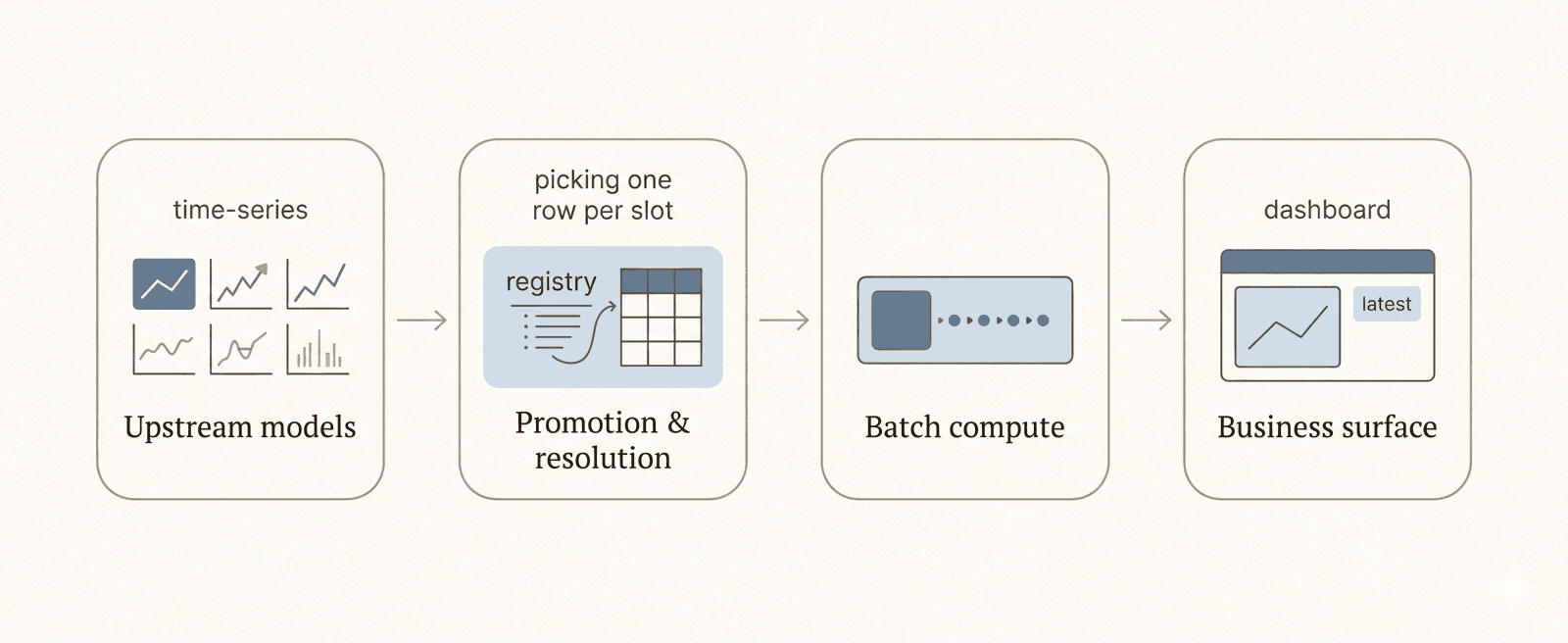
How a low-throughput ML rollup pipeline got trust, audit, and repeatability — patterns that transfer anywhere promoted outputs need a product surface.
A deep dive into one pipeline I built. If you want the pattern without the domain detail, start with the trade-offs in Part 2 and the risk tables in Part 4 and Part 5.
- Applied ML
- Pipeline design
- Orchestration
- Batch compute
- Object storage
- Part 1
When model outputs aren't enough
Promoted ML outputs without governance — no audit trail, no latest pointer, no repeatability. The systems problem behind holistic ROAS, told without assuming you care about marketing analytics.
- Part 2
Four layers, one contract
Resolver patterns, immutable taxonomy fields, and submit-time resolution — the orchestration design that turns a pile of promoted runs into one frozen batch input.
- Part 3
What we proved
Evidence from a full production compute chain — runtimes, artifacts, and the stakeholder moment where a 2.5-hour green run was mistaken for 'done.'
- Part 4
What's hard next
The remaining risk isn't batch failure — it's operational ambiguity: backfill, validation, rollback, and who owns the run button.
- Part 5
When the blocker moves upstream
Layer A and B shipped — and the remaining gate turned out to be upstream model promotion, not orchestration code.